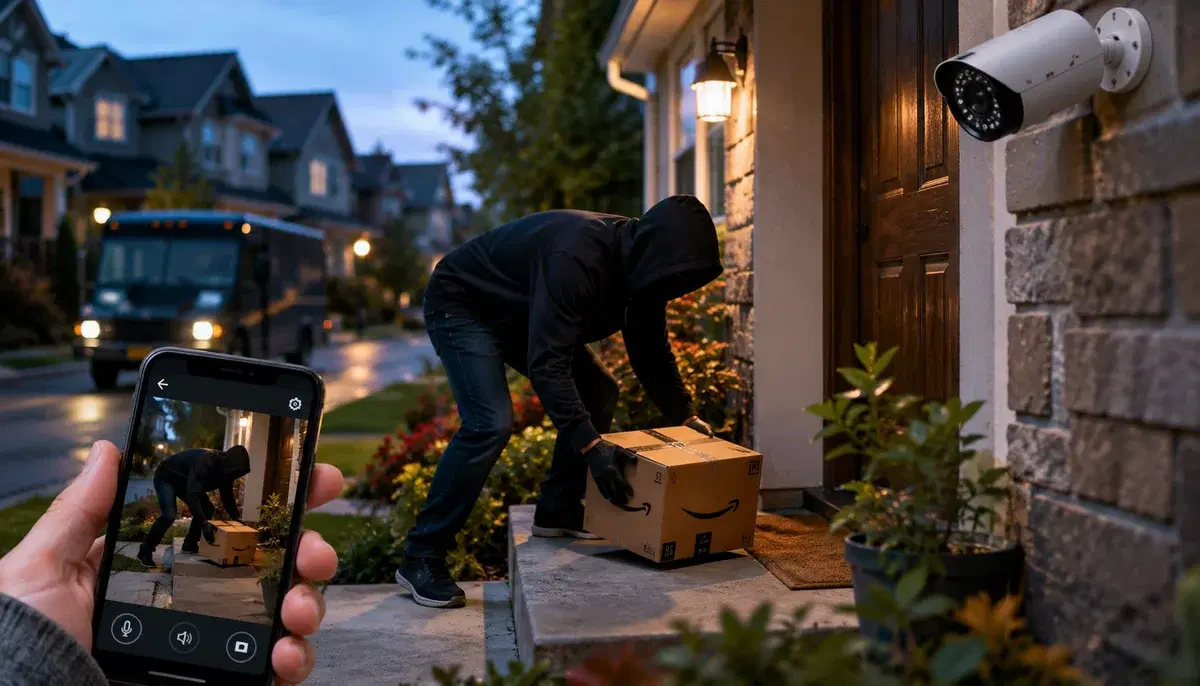
Amazon vs. Porch Pirates: The Hidden Threat and the Fight Against Stolen Packages
Published December 6, 2024
Updated 14.9.2026: An estimated 104 million packages were stolen nationwide in the past year, representing $37 billion in total economic impact, $15 billion in direct consumer losses plus $22 billion in retailer refund and replacement costs [source: SafeWise 2025 U.S. Package Theft Report]. Package theft is far beyond a holiday-only problem; it's a year-round issue, and the latest data continues to show which cities pay the highest price.
Amazon stolen packages have become a frustratingly familiar issue for online shoppers. As the world's largest online retailer, Amazon offers an extensive range of products, from books and clothing to electronics, furniture, jewelry, movies, pet supplies, toys, and more. Unfortunately, that same scale has made Amazon packages a prime target for porch pirates: the surge in deliveries has inadvertently amplified the risk of package theft, leaving customers seeking secure solutions for their purchases.
Amazon was the carrier most often named in package thefts, cited in 61.3% of cases, ahead of USPS (30.0%), UPS (26.0%), and FedEx (25.1%) [source: Omnisend U.S. Porch Piracy Report 2025]. Because Amazon delivers the largest share of U.S. e-commerce volume, it's also the carrier most exposed to doorstep theft.
Interestingly, solutions like Delivery Amigo's secure package storage offer strong protection for your online deliveries.
When Porch Pirates Strike: The Dark Side of Online Shopping
Package theft rarely looks dramatic; it's usually over in seconds. In one widely shared example, doorbell-camera footage showed a porch pirate calmly grabbing several packages off a doorstep and driving off within seconds [source: Reddit, r/porchpirates] ,a pattern that lines up with the carrier-share data above rather than an isolated incident.
While replacements from Amazon are possible, relying on them isn't a sustainable solution, especially for expensive or urgent items. Even replacement packages aren't immune to repeat theft, leaving recipients vulnerable to recurring losses. No solution eliminates the risk entirely, but taking proactive measures is always better than absorbing repeated losses. For a step-by-step recovery process, see our guide on how to deal with Amazon stolen packages.
Amazon: The Ultimate Holiday Shopping Destination
Amazon prioritizes customer experience and has set itself apart as a go-to online store. Three-fourths of U.S. e-shoppers named Amazon as their go-to platform for holiday shopping [source: Statista, 2024], and 91% of American consumers planned to shop for the holidays in 2025, with U.S. holiday e-commerce spending projected at $254.3 billion, up 5.47% over 2024 [source: Capital One Shopping — Holiday Shopping Statistics 2025].
While the retail giant works tirelessly to fulfill holiday orders, another group, porch pirates, eagerly awaits deliveries for a different reason. These opportunistic thieves watch for any unattended packages left on porches or doorsteps.
Exploring Convenient and Secure Package Delivery Options
When it comes to secure package deliveries, there are several options to consider, each with its own advantages and limitations.
PO Boxes
A PO Box, or Post Office Box, is a locked mailbox at a post office or similar postal location, offering a secure way to receive mail. Using a USPS mailbox near you lets you keep your home address confidential, a convenient solution for individuals or businesses seeking privacy or lacking a fixed address.
However, PO Boxes require in-person visits to the post office for retrieval, which can be inconvenient. They come in limited sizes, with the largest measuring 22.5" x 12" x 14.75" deep [source: USPS PO Box Size 5 / X-Large], making them unsuitable for larger packages or high mail volumes. Renting a PO Box can also be costly, especially for larger sizes. And importantly, UPS and standard FedEx services do not deliver to USPS PO Boxes.
Amazon Lockers
Amazon Locker provides a secure pickup location where you can have your Amazon orders delivered for added convenience.
To qualify for Amazon Locker delivery, your order must meet specific criteria. The shipping weight must be under 10 pounds, and product dimensions should not exceed 16 x 12 x 14 inches. Only items sold or fulfilled by Amazon.com are eligible, with a total value of less than $5,000. The order must not include hazardous materials, Subscribe & Save items, products shipping from other countries, or items designated for Release-Date Delivery, and Amazon Lockers cannot be used as delivery addresses for wishlists [source: Amazon Locker eligibility].
Package Receiving Services by Delivery Amigo
Package receiving services by Delivery Amigo offer an alternative that's convenient, adaptable, and tailored to your needs. With package storage locations closer to you that work as your secondary address, Delivery Amigo safely receives your packages until you're ready to collect them.
Delivery Amigo accepts packages up to 2 ft × 2 ft × 2 ft and up to 50 lbs, from any carrier (Amazon, UPS, FedEx, USPS, and others). Plans start at $7.50/month for up to 5 packages, or $15/month for up to 15. (Pricing per Claim C030.)
With Delivery Amigo, you get a physical street address that accepts packages from any carrier, including Amazon, UPS, FedEx, and USPS. This sets Delivery Amigo apart from PO Boxes, which only accept USPS deliveries, and gives it a distinct advantage over Amazon Lockers, which only accept items sold or fulfilled by Amazon.com. If Amazon missing packages have been a recurring headache, a Delivery Amigo location near you is the simplest way to keep deliveries off an unattended doorstep.
Frequently Asked Questions
Why are Amazon packages stolen more than others?
Amazon delivers the largest share of U.S. e-commerce volume, so more Amazon boxes sit on doorsteps than any other carrier's. In one 2025 survey, Amazon was the carrier most often named in package thefts (61.3%). It's exposure by volume, not a flaw unique to Amazon.
What should I do if my Amazon package is stolen?
Check around the property and with neighbors, then report it to Amazon (Your Orders, then Problem with Order) for a refund or replacement, and file a police report for valuable items. See our full guide on how to deal with Amazon stolen packages.
How do I stop Amazon packages from being stolen?
Keep them off your doorstep: ship to a package receiving service or staffed pickup point, use Amazon Lockers where eligible, require a signature on high-value orders, and enable delivery alerts so you can collect quickly.
Does a package receiving service accept Amazon deliveries?
Yes. A service like Delivery Amigo accepts deliveries from every major carrier, Amazon, UPS, FedEx, USPS, and others, and holds them securely until you collect them with a unique PIN.
Conclusion
When it comes to securing your Amazon packages against the rising issue of porch piracy, it's worth evaluating the available delivery options based on your own needs. Weighing the pros and cons of each will help you decide which best suits your lifestyle and security. Don't let Amazon missing packages spoil your shopping experience; choose the package delivery service that works best for you today!
Related reading
If you want the step-by-step recovery process, our guide on how to deal with Amazon stolen packages.
For real customer accounts of what porch piracy actually looks like, see the growing crisis of Amazon missing packages and stolen deliveries.
Because this article focuses on Amazon specifically, you can read about the other carriers in our companion guides on UPS lost packages and FedEx lost packages.
For the full national data picture, our cornerstone, The Definitive Guide to Porch Piracy in the United States, sits above this article in the hierarchy and covers the complete statistics and prevention landscape.
If you're weighing the cost of a PO Box, our breakdown of PO Box pricing details the fees this article's PO Box section doesn't cover.
And for readers comparing secure-address options beyond PO Box vs. Amazon Locker, our Mailbox Rental vs. PO Box comparison is the natural next step.